European building platform · Belgium
Delivered in 8–10 weeks. Fixed price. E-level −9.
A standardised building system — SIP panels, timber frame —
produced in Belgium and deployed by regional partners across Europe.
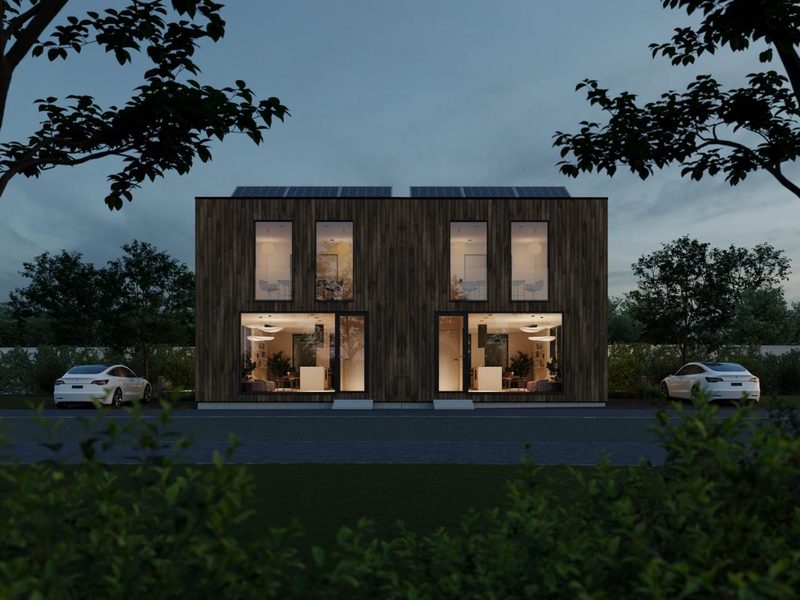
This home produces more energy than it consumes. Not a claim — a certified number.
Who is Okto.green for?
For buyers
Browse active projects across Belgium — each one built on the Nest system with a verified E-level and a regional partner behind it. Fixed price. No construction surprises.
Find a projectFor developers
Become a regional partner. You own the land, the sales and the local relationships. Okto.green provides the building system, technical support, supplier contracts and marketing tools.
Become a partnerFor municipalities
Okto.green works with Belgian municipalities on social and sustainable housing developments — with verified energy performance, transparent documentation and fast delivery timelines.
Plan a developmentThe building system
Every Okto.green home is built on the Nest system — Nest 1.0 or Nest 2.0. The design is fixed. The performance is guaranteed. No improvisation.
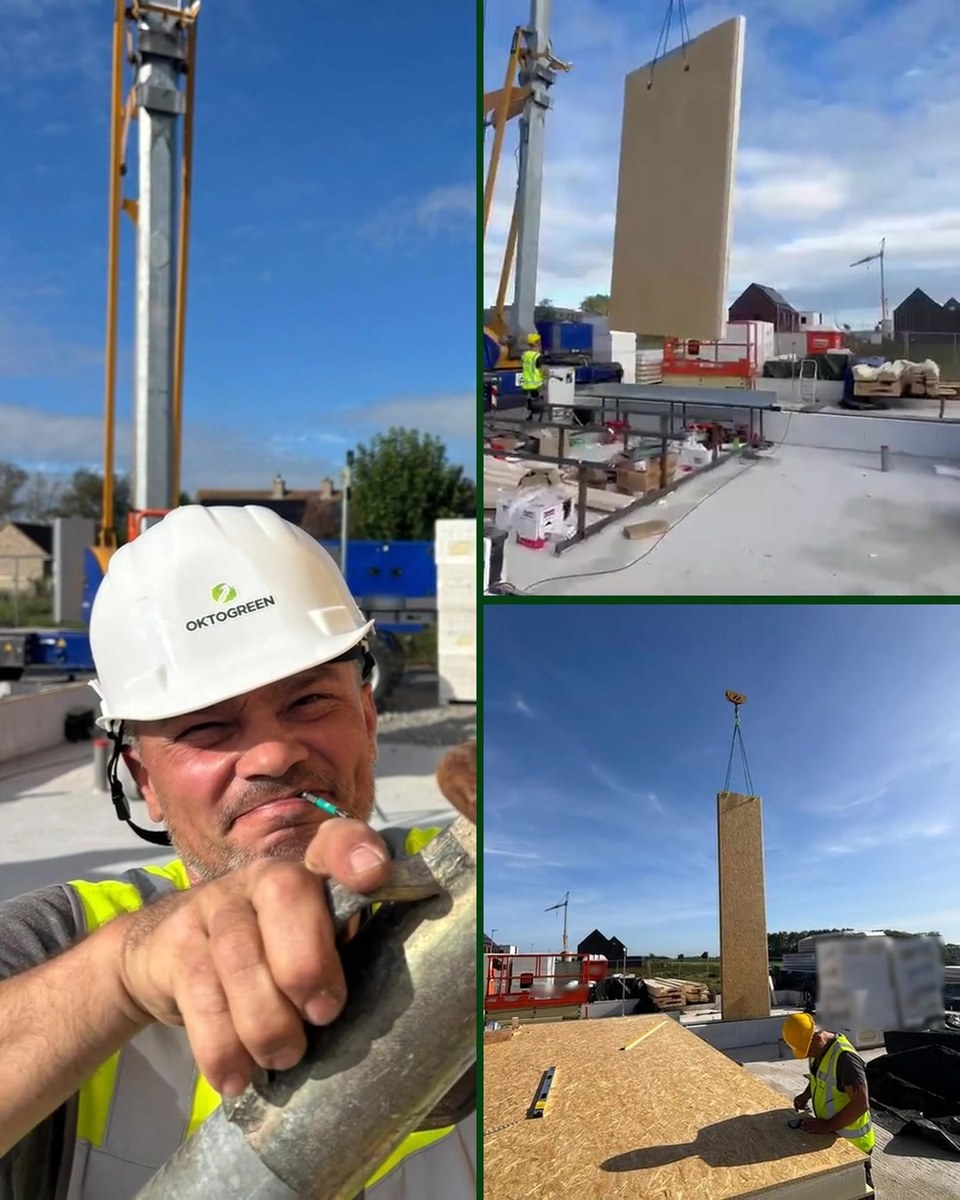
Nest 1.0 / 2.0Glulam, Kerto LVL, engineered I-joists, SIP panels with BLUE PIR core — all produced in Belgium, all pre-engineered. Assembled dry on site by a 3-person team.
Produced in BelgiumA trained assembly team completes the full build from foundation to finished structure in 8 to 10 weeks. That is the timeline. That is what gets delivered.
Fixed timelineEvery home is EPB certified. E-level −9. S-level 21. Overheating risk within limits. The numbers are public. You can verify them before you buy.
EPB certifiedActive projects
Permit submitted
Nest 1.0
Watou, West Flanders
Alkon BV
View project
In development
Nest 2.0
Handzame, West Flanders
Arber Construct
View project
Stedenbouwkundig attest (planning certificate)
11 units
Ieper, West Flanders
Arber Construct
View projectProduction & system
Every SIP panel in every Okto.green home is manufactured in Belgium. The building system — Nest 1.0 and Nest 2.0 — is engineered once and deployed by regional partners wherever the system scales.
What every Nest home includes
For regional developers
As a regional partner, you bring the land, the local market knowledge and the sales. Okto.green brings the building system — SIP panels, technical protocols, supplier contracts and platform support. You keep 50% equity. The system scales with you.
Four projects in West Flanders — two building permit tracks, two subdivision tracks at different stages.

Site photography to be added · 6 photos available from permit set BA 12


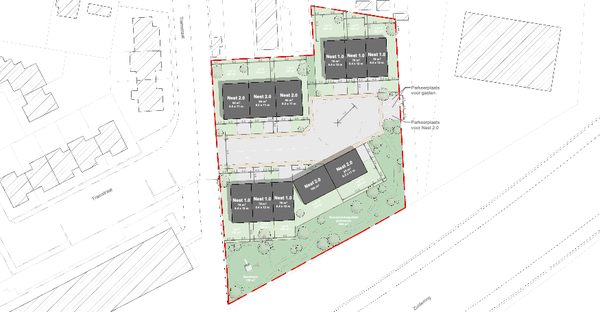
A compact energy-positive neighbourhood of 11 homes on a fully enclosed inner-block site in Ieper, organised in three clusters around a 844 m² collective green zone. The project uses two Okto.green home types: 6 × Nest 1.0 (78 m²) for starters and couples, and 5 × Nest 2.0 (90–106 m²) for families.
The site is located within RUP Kruiskalsijde II — Zone 2 (residential, enclosed building). A planning certificate (stedenbouwkundig attest) was submitted to the City of Ieper in June 2026 to confirm the site's buildability and the access road via Tramstraat. A positive decision enables a direct subdivision application without RUP amendment.
Every component in a Nest home is part of an engineered system — not a collection of standard building materials assembled on site. This is what makes the difference between a house and a system.
Every choice in the Okto.green Building System is a deliberate improvement over the conventional platform timber frame. This is not a standard house with better insulation. It is a different structural logic.
From facade finish to interior board, every layer has a defined function. The only colour in this drawing is the one that matters.
The insulation core in every wall panel and roof layer is BLUE PIR — produced from recycled PET bottles, manufactured in Belgium. The number you see on the right is what sits inside the walls of your home. Verified against supplier specification. No certification claim — just a fact.
E −9 is not a target — it is the reference value the Okto.green Building System is designed to achieve on every project. Below the E-level norm by more than 100%. The numbers below are from the EPB studies for Watou (Nest 1.0) and Handzame (Nest 2.0).
Four active projects in West Flanders — building permits, subdivisions, first pilot under construction.
Regional partner
Okto.green is not a franchise. It is a building system you operate in your region — with your land, your clients, your market knowledge. Okto.green provides the technical protocol, supplier contracts and platform governance. Oktopro gives you the tools to run every part of your operation. You keep 50% equity in every project.
What you own
As a regional partner you are the local operator. You acquire the land, manage the sales process and handle relationships with buyers and local authorities. You are not a subcontractor — you are the project developer in your region.
What Okto.green brings
Okto.green controls build quality, supply chain and technical standards — so every project delivers the same verified energy performance, regardless of region.
The building system
Every house in the Okto.green network is built from the same technical core — a standardised structure that achieves E −9 on every project. You deploy it in your region. We make sure it works.
Platform support
Being a regional partner means running a serious local operation. Land acquisition, permit tracking, supplier ordering, financing structure, site coordination — each of these has its own complexity.
Oktopro is the construction operating system built to support exactly this. Not generic project management — a purpose-built platform for regional developers operating the Okto.green building system.
oktopro.comHow it works
Financial model
Okto.green holds a 50% equity stake in every project built through the network. Bank payment releases are milestone-triggered — warehouse validation, platform confirmation, timeline alignment. No payment without delivery. This is not a franchise fee. It is a shared ownership model.
Okto.green is currently active in West Flanders with two regional partners. We are selectively onboarding new partners for 2026–2027 in Belgium and neighbouring regions. The first conversation is a 30-minute call — no presentation, no pitch deck.
For municipalities
Municipalities initiate and shape projects with Okto.green. A regional partner builds in your area — using the Okto.green Building System. Social housing, climate-positive neighbourhoods, municipal land development. One conversation with us is where it starts.
How it works
Okto.green does not build directly. We operate through a network of regional partners — local developers who carry the Okto.green Building System into their area. As a municipality, you initiate the project with us. We connect you with the right regional partner, who takes it from there — with full platform support and our technical governance throughout.
What municipalities work with us on
Municipalities with a social housing obligation can deliver energy-positive units via the Okto.green Building System — with verified E-level documentation, fixed pricing and a 36-day build protocol that eliminates construction risk.
For municipalities with climate ambitions or BREEAM targets, Okto.green delivers residential projects with measurable, independently certified energy performance — replicable across multiple plots in your area.
Municipalities with available land can bring Okto.green in as the building system partner. Transparent contract structure, milestone-based delivery and a full audit trail via the Oktopro platform at every stage.
What you get
Every Okto.green project comes with the same verified package — independent of which regional partner builds in your municipality.
Reference project
A Nest 2.0 project on the Meenseweg in Ieper — developed in partnership with the municipality. Permitted via subdivision track, built by Arkelo BV, regional partner for the Ieper region.
View all active projectsWhether you have a specific plot, a social housing obligation or a climate target — the first step is a straightforward conversation. We will tell you exactly what Okto.green can do for your municipality.
Partner network
Okto.green operates through a network of regional partners — local developers who carry the Okto.green Building System into their area. We started in Belgium. We are building the network to scale the system across Europe, one regional partner at a time.
The network
The Okto.green Building System is designed from day one for cross-border replication. The technical core — the energy standard, the build protocol, the certification process — is the same in every country. What changes is the regional partner: a local developer who knows the land, the market and the planning rules.
We are currently active in West Flanders with three partners. In 2026–2027 we are selectively onboarding partners in new Belgian regions and beginning our first cross-border expansions.
Open for new partners
New Belgian regions · Poland · Romania · Netherlands · France · Germany · and all EU countries
Active partners · Belgium
If you have land, local market knowledge and the ambition to develop energy positive housing in your region — we want to talk. The system is ready. We are looking for the right partners to deploy it.
Become a regional partnerAbout Okto.green
Okto.green is a European building platform for energy positive homes. We standardise the technical core — the building system, the supply chain, the certification process — and deploy it through a network of regional partners across Belgium and beyond.
What we do
Okto.green does not sell houses. We build and govern a standardised construction system that regional partners use to develop energy positive homes in their area. Every house in the Okto.green network is built from the same technical core — achieving E −9 on every project, documented and independently certified.
The system is replicable. A regional partner in West Flanders builds the same way — with the same energy result — as a partner in Ghent or Antwerp. That is the point. Standardisation is not a limitation. It is the guarantee.
The platform ecosystem
Okto.green operates within an ecosystem of interconnected platforms — each with a specific role in the construction and delivery process.
Where we are
Okto.green is currently active in West Flanders with three regional partners and four projects in permit or subdivision track. The system is designed from day one for cross-border replication — same technical core, adapted to local building regulations.
New regional partners are being selectively onboarded for 2026–2027 — in Belgium and in neighbouring regions.
One email address. The right person responds depending on your question.
Knowledge base
Definitions, context and practical meaning for every term used in Okto.green projects — from E-peil to regional partner. Written for buyers, partners and municipalities alike.
The E-peil (energy level) is a dimensionless number expressing the overall energy performance of a building. The lower the number, the less energy the building needs. A negative E-peil means the building produces more energy than it consumes.
In Vlaanderen, the legal maximum for new residential construction is E30 — the BEN standard. Okto.green projects achieve E −9: 130% below the legal norm. Calculated by an EPB reporter based on insulation, airtightness, ventilation, heating system, renewable energy and orientation. Homes with E-peil ≤ E20 receive a 100% exemption from property tax for 5 years.
The S-peil (shell level) measures the energy efficiency of the building envelope — walls, roof, floor, windows and orientation — independent of the heating system.
The legal maximum in Vlaanderen is S28. Okto.green projects achieve S21 — 25% below the norm. A low S-peil means the building shell limits heat loss and solar overheating before any technical installation is needed.
The overheating indicator (in Kelvin-hours, Kh) measures how often indoor temperature exceeds a comfort threshold during the year. Lower is better.
The legal maximum is 6500 Kh. The Watou Nest 1.0 project achieved 4580 Kh — 30% below the norm. Achieved through thermal mass, controlled solar shading and the airtight shell.
A BEN-woning (Bijna-Energieneutraal — Nearly Zero Energy Building) meets the Belgian energy standard: maximum E30 and at least 15 kWh/m² of renewable energy production per year. Since 2021, every new residential building in Vlaanderen must meet this standard.
Okto.green homes exceed the BEN standard significantly. At E −9, they are energy positive — producing more energy than they consume. The difference between a standard BEN woning (E30) and an Okto.green home (E −9) translates to 40–60% lower energy costs in practice.
An energy positive home produces more energy than it consumes over the course of a year. The surplus is fed back into the grid or stored in a home battery. Expressed as a negative E-peil — E −9 means the home produces 9 points more than a reference building of the same size would consume.
Achieved through high-performance insulation, an airtight building shell, a heat pump, mechanical ventilation with heat recovery, and a PV installation sized to produce a surplus. All Okto.green homes — Nest 1.0 and Nest 2.0 — are certified at E −9.
EPB (Energieprestatie en Binnenklimaat) is the Flemish regulatory framework for energy performance requirements. The EPC (Energieprestatiecertificaat) is the certificate issued after an EPB study — it documents the E-peil, S-peil and overheating indicator.
Every Okto.green project requires an independent EPB study. The EPC is delivered at handover and required when selling or renting. Homes with E-peil ≤ E20 receive a 100% exemption from property tax for 5 years.
Airtightness measures how much air leaks through the building envelope when pressurised to 50 Pascal. The n50 value expresses air changes per hour. Lower is more airtight and more energy-efficient.
The standard EPB reference value is 6.0 when no test is performed. Well-built homes achieve between 1 and 3. Okto.green's building system achieves below 1.0, directly reducing both E-peil and heating demand. Measured via a blowerdoor test at end of construction.
Nest 1.0 is the standalone single-family unit in the Okto.green Building System — a detached home on a single residential plot. Every Nest 1.0 achieves E −9, S21 at a fixed certified price.
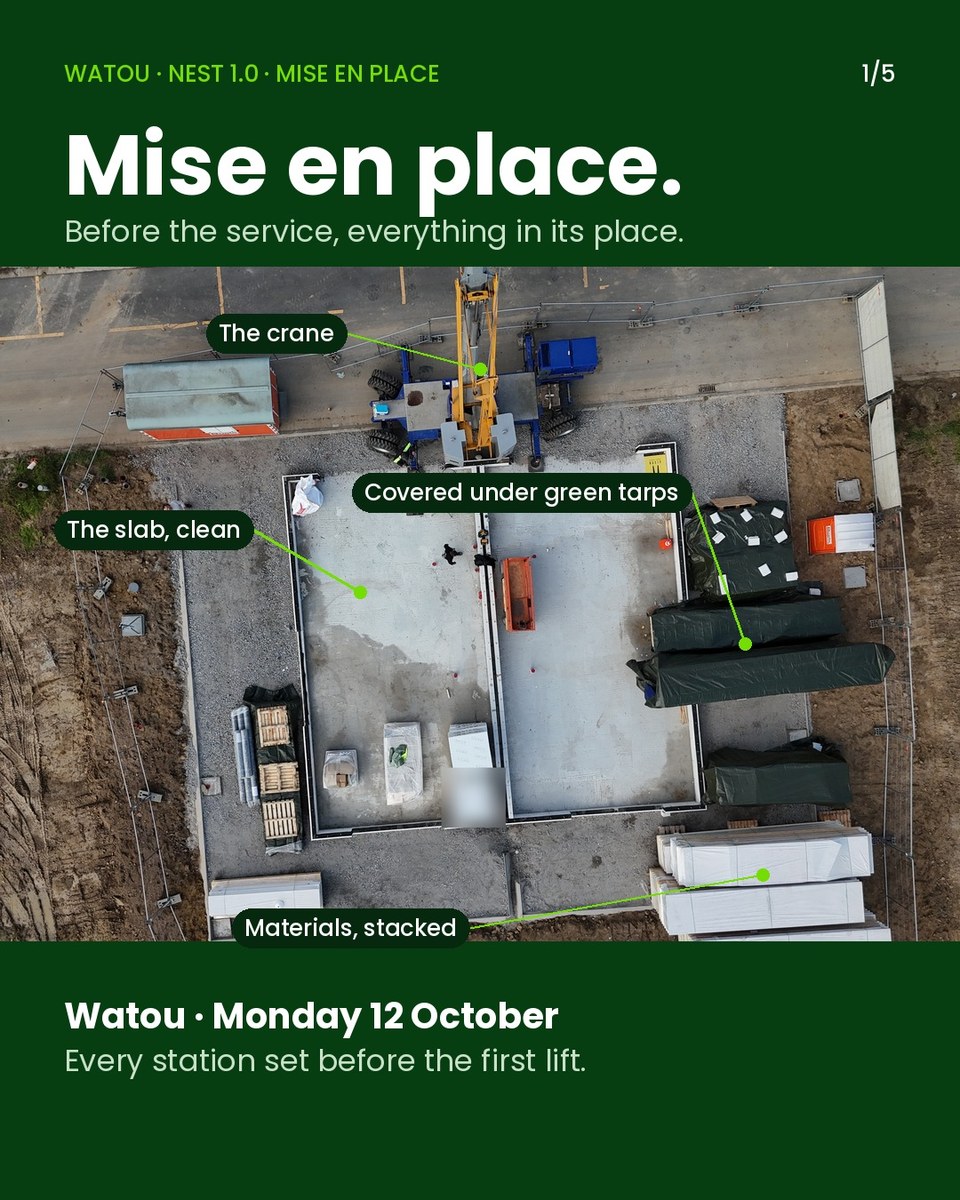
Suitable for building permit and subdivision tracks. Reference project: Watou — Gebroeders Faesstraat, built by regional partner Alkon BV in West Flanders.
Nest 2.0 is the semi-detached configuration — two or more units sharing a structural wall, increasing land efficiency while achieving the same E −9, S21 result as Nest 1.0.
Preferred for larger subdivision tracks and municipal housing programmes. Active projects: Handzame (Arkelo BV) and Ieper — Meenseweg (Arber Construct).
The standardised structural and technical method used in every Okto.green project — defining materials, build sequence, energy targets, supplier contracts and quality controls that every regional partner applies.
Timber frame structural core, high-performance insulation, airtight membrane, triple glazing, heat pump and PV installation. Components produced in Belgium, delivered on a fixed procurement schedule. Result: 36-day build protocol from foundation to wind and watertight.
A heat pump extracts heat from the environment — air, ground or groundwater — and transfers it into the building. It produces 3 to 5 units of heat per unit of electricity (COP 3–5), making it the most energy-efficient heating system for low-energy buildings.
Since 2026, a heat pump or equivalent renewable heating system is mandatory in all new construction in Vlaanderen. Gas connections are no longer permitted. Every Okto.green home includes a heat pump — specified and procured through the supplier network at a fixed price.
Thermal mass is the capacity of a building material to absorb, store and slowly release heat — buffering temperature fluctuations and reducing both overheating in summer and heating demand in winter.
Integrated into the Okto.green Building System to achieve the low oververhittingsrisico result. Watou project: 4580 Kh — 30% below the legal maximum of 6500 Kh.
A blowerdoor test measures the airtightness of a completed building by pressurising it to 50 Pascal and measuring how much air escapes per hour. The result is expressed as the n50-value — air changes per hour at 50 Pascal.
Without a blowerdoor test, the EPB reporter must use a default n50 value of 6.0 — which significantly raises the calculated E-peil. A well-built Okto.green home achieves below 1.0, reducing the E-peil by several points. The test costs €350–550 and is conducted at the end of construction before the final EPB declaration. At Okto.green, the blowerdoor test is part of the standard build protocol — not an optional extra.
BLUE PIR is a polyisocyanurate rigid foam insulation board with a characteristic blue colour — produced from recycled PET bottles. It forms the insulation core of every SIP panel in the Okto.green Building System, in both wall panels and roof layers.
Thermal resistance: Rd 6.05 m²K/W. U-value: 0.17 W/m²K. Fire classification: REI 60. Thickness in wall panels: 140 mm PIR core + 15 mm OSB on each side. A Nest 1.0 unit contains approximately 1500 recycled PET bottles worth of BLUE PIR in walls and roof. A Nest 2.0 unit contains approximately 1800. The blue you see in technical drawings is not a design choice — it is the material itself. Produced in Belgium.
Kerto-LVL (Laminated Veneer Lumber) is an engineered wood product used as the floor structure in Okto.green homes. Thin wood veneers are glued together under high pressure, creating a uniform, dimensionally stable structural beam with no knots, no natural defects and consistent strength over the full length.
LVL resists warping and shrinking under moisture changes — a critical property in airtight low-energy buildings where humidity is controlled. A Kerto-Ripa floor panel weighs ±34 kg/m² versus 675 kg/m² for reinforced concrete — 20× lighter, without compromising span or load capacity. Used instead of solid timber joists, which contain knots and natural weak points that can cause post-completion cracking and joint movement.
Mechanical ventilation system D (balanced ventilation with heat recovery) supplies fresh air to living spaces and extracts stale air from wet rooms simultaneously. A heat exchanger recovers 85–95% of the heat from the extracted air before it leaves the building.
In an airtight building like an Okto.green home, controlled mechanical ventilation is essential — the building cannot "breathe" through gaps and cracks as a conventional house would. Systeem D ensures air quality without energy loss. The system is mandatory in BEN-woningen and directly contributes to the low E-peil by reducing ventilation heat losses. Every Okto.green home is equipped with a Systeem D unit as standard.
The U-value (thermal transmittance) measures how much heat passes through a building component per square metre per degree of temperature difference — expressed in W/m²K. The lower the U-value, the better the insulation.
Flemish building regulations require a maximum wall U-value of 0.24 W/m²K for new construction. The Okto.green wall panel achieves 0.17 W/m²K — 30% better than the norm. This is achieved through the 140 mm BLUE PIR core combined with the OSB structural boards on each side. The U-value is directly related to the Rd-value (thermal resistance): U = 1/Rd.
A PV installation (photovoltaic system) converts sunlight into electricity. In an Okto.green home, the PV installation is sized to produce a surplus beyond the home's annual consumption — directly contributing to the negative E-peil and making the home energy positive.
Flemish building regulations require a minimum of 15 kWh/m²/year of renewable energy production since 2025. Okto.green homes exceed this requirement. The surplus electricity is fed back to the grid or stored in a home battery. The PV installation is included in the fixed price and procured through the Okto.green supplier network — specified per unit type based on roof surface and orientation.
The omgevingsvergunning (environmental permit) is required for new construction, major renovations and changes of land use in Belgium. It replaced the bouwvergunning and verkavelingsvergunning in 2017.
The EPB requirements — including E-peil and S-peil — are determined by the year the permit is requested, not when construction starts. Permit track: typically 60 to 150 days. Okto.green manages all technical documentation for submission.
A verkavelingsaanvraag (subdivision application) is required to divide a plot into two or more separate building lots. It is a separate track from the construction permit and typically precedes it when multiple units are planned.
Handzame (Arkelo BV) and Ieper — Meenseweg (Arber Construct) follow the subdivision track. Typical duration: 3 to 6 months. A stedenbouwkundig attest can verify feasibility before the full application.
A preliminary planning certificate from the municipality confirming whether a proposed construction or subdivision is in principle acceptable under local planning rules. Not a permit — but provides legal certainty before a full application.
Okto.green and regional partners request a stedenbouwkundig attest at the start of every new subdivision project — including Ieper — Meenseweg (Arber Construct).
An EPB reporter (EPB reporter) is a certified professional responsible for calculating and declaring the energy performance of a new building or major renovation. They submit the EPB declaration to VEKA (Vlaams Energieagentschap) and issue the EPC at handover.
The EPB reporter is independent of the contractor — they verify that the as-built building meets the declared E-peil and S-peil. They must be engaged before the start of construction and submit a start declaration (startverklaring) within 8 days of the first works. Failure to comply can result in fines from VEKA. On every Okto.green project, the EPB reporter is appointed by the regional partner as part of the standard permit track.
The onroerende voorheffing (property tax) exemption is a Flemish fiscal benefit for new homes with a low E-peil. Homes with E-peil ≤ E20 receive a 100% exemption for 5 years. Homes with E-peil between E21 and E30 receive a 50% exemption.
For an average home, this represents a saving of €600 to €2,500 per year, depending on the municipality — or €3,000 to €12,500 over 5 years. At E −9, all Okto.green homes qualify for the full 100% exemption. The exemption is applied automatically based on the EPC issued at handover — no separate application is needed. This is one of the most direct financial benefits of building energy positive rather than merely meeting the BEN standard.
A local developer or construction company that operates the Okto.green Building System in their region. They own the land, manage sales and local authority relationships, and hold 50% equity in the regional development entity — with Okto.green holding the other 50%.
The regional partner is not a subcontractor or franchisee — they are a co-owner of the entity that develops Okto.green projects in their area. Current partners: Alkon BV (Watou), Arkelo BV (Handzame), Arber Construct (Ieper).
The construction operating system used by Okto.green and its regional partners. Manages process integration, supplier orchestration, permit tracking, financing workflows and build intelligence across all projects in the network.
Every regional partner operates through Oktopro — from land acquisition and permit coordination to procurement and the 36-day build protocol. The platform ensures every project follows the same standardised process, regardless of region.
The price of an energy positive home depends on unit type, plot and regional partner. Okto.green works with a fixed price per unit type — set before the permit is submitted. There are no construction surprises and no cost escalation.
The fixed price includes the complete building system: structure, insulation, airtight membrane, windows, heat pump, mechanical ventilation and PV installation. It does not include the land, foundations, utility connections or interior finishing. For indicative pricing, contact the regional partner for your area via [email protected]. The total cost of ownership is significantly lower than a standard new-build: at E −9, energy costs are 40–60% lower, and the 100% property tax exemption for 5 years reduces the net cost further.
A BEN-woning (Bijna-Energieneutraal) meets the legal minimum: E-peil ≤ E30. An energy positive home goes further — it produces more energy than it consumes, resulting in a negative E-peil. Every new home in Vlaanderen must be BEN since 2021. Not every new home is energy positive.
In practice: a standard new-build at E30 consumes roughly 40–60% more energy than an Okto.green home at E −9. That difference translates to €600–1,200 per year in energy costs, plus the property tax exemption (100% for E ≤ E20, which Okto.green homes qualify for). Over 20 years, the difference in total cost of ownership between a BEN woning and an Okto.green home is typically €40,000–70,000.
Yes. Since 2026, all new residential buildings in Vlaanderen must be equipped with a heat pump or equivalent renewable heating system. Gas connections are no longer permitted for new construction.
This applies to all building permit applications submitted from 1 January 2026 onwards. The heat pump must achieve a minimum heating efficiency of 130% (COP ≥ 1.3, which all air-water and ground-water heat pumps exceed). Combined with a well-insulated airtight building and a PV installation, a heat pump is the primary driver of a low E-peil. All Okto.green homes include a heat pump as standard — fully specified and procured through the supplier network at a fixed price.
The Okto.green 36-day build protocol takes the structure from foundation to wind and watertight in 36 working days — approximately 7 weeks on site. The structure is wind and watertight within 3 weeks. This is significantly faster than conventional on-site construction.
The speed is possible because the building system uses prefabricated components produced in Belgium: SIP panels are pre-cut to specification before delivery. On site, assembly is a precision operation, not an improvisation. The 36 days cover structural erection, SIP panel installation, roof, windows and airtight membrane. Interior finishing, technical installations and facade cladding follow in the standard finishing phase. Total time from permit to handover is typically 8–12 months, of which the permit track (60–150 days) and utility connections are the longest elements.
Becoming a regional partner starts with a 30-minute conversation — no pitch deck, no presentation. Okto.green is selectively onboarding new partners for 2026–2027 in Belgium and neighbouring regions.
The partner profile: a local developer or construction professional with access to land, knowledge of the local market, and the capacity to manage a residential development project. Okto.green provides the building system, supplier contracts, technical validation and platform governance via Oktopro. The regional partner owns 50% of the development entity — Okto.green holds the other 50%. Contact: [email protected].
Municipalities do not build directly with Okto.green — they initiate a project by contacting Okto.green, who then connects them with the right regional partner for their area. The regional partner manages the development on the ground.
Three entry points for municipalities: social housing obligations, climate-positive neighbourhood development, and municipal land development. Okto.green handles all technical documentation — EPB studies, structural drawings, engineering. The regional partner manages the local permit track. Every project is delivered with certified EPB documentation, fixed price and the 36-day build protocol. Contact: [email protected].